Lee is great to work with – he is patient, hard-working and a determined and creative problem solver. Never fazed by ‘client demands’ Lee is always responsive and feels like an integral part of my team.
Blog Archives
Penny de Valk

Client: Penny de Valk
Brief: Develop an online presence allowing visitors to book virtual sessions, check calendars and read inspirational content.
Penny de Valk approached Point and Stare after a selection process that included ‘being found on Google’. It seems we proved our work speaks for itself and the project commenced.
Ongoing technical and marketing support ensures the project not only achieves it’s first objective but keeps on delivering.
Penny loved the delivered project so much she gave a glowing testimonial:
Lee is great to work with – he is patient, hard-working and a determined and creative problem solver. Never fazed by ‘client demands’ Lee is always responsive and feels like an integral part of my team.
The failing fear of failing

What stops you from just going for it, from just saying yes, from stepping just outside your norm?
The fear of failing can be painful, paralysing, demoralising and the fear of failing again after a big hit is much worse.
If none of us ever grabbed ourselves by the balls and took that initial step forward we’d all be wishing we had.
But what if? Do you have the courage to say ‘YES’ to your next project before panic starts to creep in?
We all fail perfectly
Without failure, you don’t learn, without learning, you don’t grow.
Learning from failure will help you pull through quickly both emotionally and psychologically and improve your chances of winning next time.
We failed because of what? Our timing was out? We took bad advice? The product wasn’t perfect?
Sometimes we strive to be perfect until perfection takes a negative toll on us, our business or our relations.
The reality is that most of us are scared of failing so we try to make perfection the goal or even use perfection as the excuse to put the launch back.
People can be determined at all cost to be perfectionists then end up failing no matter how hard they try, no matter how much cash they spend, no matter the other sacrifices they’ve made. The danger of waiting for perfectionism is that it comes with side effects that have a psychological burden on the success of businesses and personal lives.
Plasters give confidence
If you have challenged yourself to be better emotionally, physically, creatively, at some point, you will trip. The courage to pick yourself up and move on is the trick but there is no magic if you don’t also learn. Whatever name you prefer to give failure – a gift, a mistake, a lesson – it does not change the fact that it is going to happen often in our lives. Don’t let failure dictate your [e]motion. Get up and continue running while the fear is still fresh and the grazed knee is still sore – lesson = carry a plaster next time.
The more we learn, the more competent we are going to be in our life and in business.
When lessons are learned and expertise is built, confidence to fail is gradually developed too.
GDPR and website forms – an easy peasy guide
As a business you must be aware that speeding up the cold lane is the deadline for firms to update their processes to being GDPR compliant.
Essentially, this means treat your users, your subscribers, your customers data with respect.
GDPR = Generally Do Participation Right?
As a business you will more than likely come across a time when you have to use a form on your website – a newsletter subscription, contact form etc.
Up until now you would simply build something that consists of name, email and maybe even a paragraph text area for comments.
If you’re selling products maybe even a few select menus with choices etc.
So, nothing unusual about that, but, how do you make sure you don’t fall foul of the GDPR rules and end up with a $20million fine? Pay a GDPR gooroo £thousands? No, it’s easier than that – add an option for the user to opt-in.
Obligate the opt-in option
Let’s presume you have a form already on your website. It consists of fields for name, email address and a section for comments and, of course, the submit button.
Just below all these default fields, you will need to add a checkbox or radio button with relevant text – something like “i agree to you collecting and storing my data and I have read your privacy policy … “ with a link to your privacy policy etc.

There are a few more steps to take but, that’s basically all you need to do on your on-site forms.
While you’re sniffing around in the admin area of your website, you should also take a look at your privacy policy.
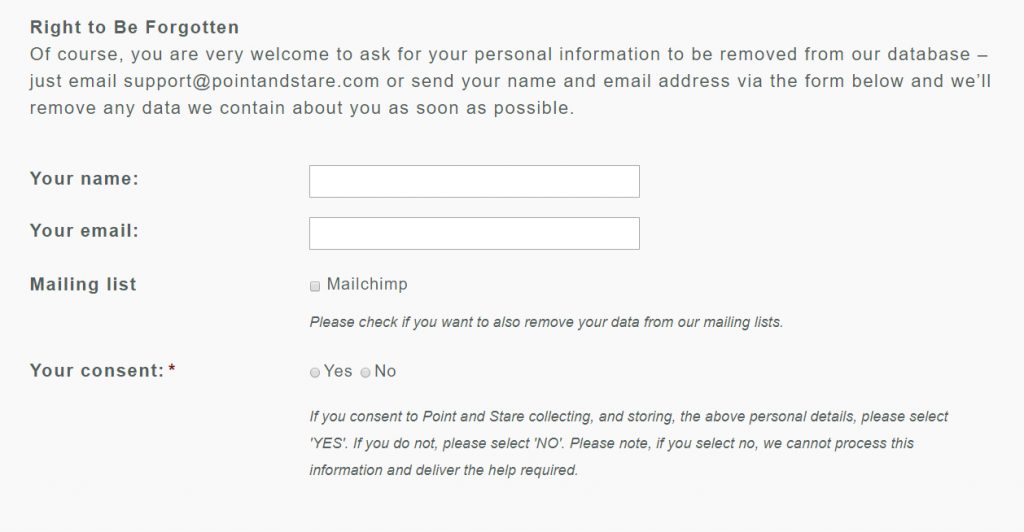
One area that people are not yet adding is what is known as ‘Right to be forgotten’. In general, this allows your subscribers etc to request any data you hold on them to be destroyed.
Again, very simple to do, just add a form, like the one below.
We have a mailing list that people can be added to, therefore, we store those details on our account with Mailchimp – we also added a choice for staying on the mailing list or not – see this in action on our privacy policy.
Of course, I am not a legal expert and all the above information is not legally binding and could even be incorrect, to which I am more than happy to correct, but, cannot be held legally responsible.
If you need help getting your business website GDPR compliant, of course, contact us direct today.
The Rise of Video Marketing on Social and How It Affects Your Business

So, the master of ‘doing stuff on video’, has a new article outlining, of all things, the rise of video marketing.
As usual, the article is loaded with tons of jabs and is essentially bang-on with all the advice and pointers you could need to convince you that video marketing is not only recommended, it’s crucial.
Read on below and when you’ve finished, have a pop at these 2 destinations – Gary Vaynerchuck and The Ask Gary V Show and for a bunch of random Gary Vee vids, check the Random Vee.
The Rise of Video Marketing on Social and How It Affects Your Business
The single most important strategy in content marketing today is video. Whether it’s video on Facebook, Twitter, Snapchat or Youtube, the content you need to be thinking about creating and marketing on social for your business is video. Period.
No matter what you’re selling, no matter what your company does, if you don’t have a video marketing strategy for the biggest video platforms, you are going to lose. And in case you haven’t noticed, the platforms of distribution for video content online have shifted drastically over the last 18 months. Facebook is getting more daily minutes watched than YouTube, Snapchat’s daily views are now in the billions, and video on Twitter has taken listening and one to one branding to a whole new level.
Now, maybe I’ve scared you a bit, but don’t worry because I’m here to make sure you understand the landscape of all the biggest social platforms that matter right now. By the end of this article, you’ll have the information you need to kill at video. I promise.
YouTube Video is a Library of Content
Let’s get started with the obvious, the granddaddy of video online: YouTube. Here is why I won’t be drilling down on strategy for YouTube in this article. I know, you’re already sceptical, but hear me out. YouTube is huge. I’m not denying that. It’s a library of video content: 300 hours worth of video content are pushed to YouTube every minute. Heck, I even got my start there with a popular show about wine. It helped me launch a career and grow a personal brand. And for that reason, I still find YouTube valuable for business. In fact, I have another show on there now that is doing similar things for me that the earlier wine show did. Growing my brand. Reaching new audiences. So it’s clear that over the years, YouTube continues to be a video content giant for businesses and personal brands.
But the problem with YouTube is that it’s in a downward trend compared to Facebook’s 4 billion daily video streams; A number that’s only going to continue to grow with time.
Due to its sheer size, there’s a ton of competition amongst videos on YouTube all fighting to be seen. When you have a platform with over a billion users, all wanting the same thing (exposure), it’s going to get noisy. And it’s been figured out. Marketers have ruined it. Because of that, it’s much harder to break through the noise which makes hosting your content on the platform much less valuable.
Additionally, it doesn’t have the capabilities of other growing video platforms, and so far, they haven’t shown signs of catching up.
“So, what exactly are those capabilities other platforms have?” you might ask.
Well, here’s the big one: data. Data data data. And the leader in that domain is, without a doubt, Facebook.
Video on Facebook is Good at Everything: Smart, Shareable & Personal
Facebook video for my brand has become the best way to reach my fans at scale. Couple that with their new video ad products for sales and direct response and the fact that they’re the greatest data company of all time for marketers and you have some serious reasons to spend some real money on Facebook video ads and video content for Facebook.
Think about it for a second. If you’re creating video content for YouTube, and not putting those videos onto Facebook as well, your brand or business is losing distribution – not to mention relevancy. No questions asked.
And I don’t mean cross channel promotion by pasting a link to YouTube on your Facebook page as a status update. I mean uploading the video natively to Facebook, so that it lives in your Facebook page’s video content. Why? Because right now, Facebook’s Newsfeed algorithm is placing an enormous amount of weight on videos, otherwise known as “reach.” When you upload videos natively, instead of linking out, you have a much higher chance of your video being seen by your community (and new fans, too). Google and Facebook are competitors, so if you think Facebook wants to have YouTube links perform well in their Newsfeed algorithm, you better think again.
YouTube should honestly be concerned; Facebook is already on its way to becoming a massive competitor when it comes to video marketing and content distribution. They are sitting on an enormous amount of targetable consumer data. It creates the ultimate marketing machine. For example, let’s say you upload a video natively, like I talked about before, about the best places to eat ice cream outdoors in your town. You could then spend money on a sponsored video to directly market your brand’s video to people who 1) love ice cream and 2) live in your area and 3) have kids. Automatically, you’re reaching the audience who is most interested and profitable to your business — Which is great, because you’re not wasting anyone’s time, and you’re truly reaching the consumers who will be interested in your business’s offering.
Get it? Facebook gives you the ability to target consumers like we’ve never seen before in digital.
And Facebook knows. They’ve added features in the last few months that point to the fact that they are increasing the amount of attention they give video: view count, embedding options, video for website conversions. This means there is more to come.
But while Facebook should be an enormous priority, don’t ignore the other social channels that might be more intune with your brand. There are a ton of other social channels to be creating video content for that offer what marketers love — reach and attention.
I’ll go into a couple of the biggest ones.
Video on Twitter is for Engagement: Direct, Social, & Real
Twitter’s new video product that was released late January has changed the way I use and consume the platform. Video on Twitter truly is social and the best way to use Twitter video is by connecting and engaging, rather than just pushing. As Twitter has grown in size, it’s become a listening platform. Six years ago, I could send a tweet and get more engagement on it than I do now. I had less of an audience, but the audience was paying closer attention. It was more serious. Now the amount of information and users on that platform has gotten so intense that it’s hard to have that same engagement. It’s hard to get anyone’s attention.
That’s why the game, the real way to win with Twitter video, is through engagement — using it as a “pull” rather than a “push.”
The truth is, people respond to effort. When a celebrity favorites your tweet, you get excited. Someone you admire likes a photo of yours on Instagram, it makes you feel good. Because, in reality, it’s not about the 100th of a second it takes to double tap that photo — it’s about the fact that they looked at your profile. They chose a photo. They saw it. And they “liked” it. That interaction, which takes all of 5 or 6 seconds, really touches people in a way that is unique to the powers that be on social.
With Twitter’s new video feature, they’ve been able to take that feeling to the next level.
All you have to do is get in there and engage. Reply to a tweet using the camera option, select video, and start talking. It takes me nine to twelve seconds to make a video and reply, but those extra seconds hold a lot of meaning. Not to mention it’s more personal, visual, and we are living in a world where the visual is often regarded as a better engagement than the written.
There’s also more room to set the tone. A lot of things can get lost in a tweet. I might say “thnx” but that person isn’t 100% sure what my tone really was. But with Twitter video, the message comes across loud and clear.
It’s fifteen seconds of your attention on one person instead of two seconds. Do you know how much that means? Time is so incredibly precious to people. We are in control of it and we hate when it’s wasted. But you know what we value more? When someone else decides to lend their most precious asset to us.
That is what excites me most about Twitter video. Giving time to people. More time. Personalized time. And that is awesome.
Snapchat Video is the Hottie at the Gym: It’s All About Attention
Lastly, Snapchat.
Snapchat is huge right now.
More than 60% of U.S.13 to 34 year-old smartphone users are Snapchatters (2005).
They now have more than two billion video views a day (2005).
And there are a few interesting things about Snapchat as a platform when it comes to how it works.
Snapchat gets your undivided attention because, in order to view a video, you have to have your finger on the screen.
It’s also one of the only platforms in which you can draw creative on top of the video, making for some awesome Snapchat exclusive artists like Shonduras.
Most importantly, videos have a maximum life of twenty four hours, or less if the users chooses to make it so. A video can last down to a second. The urgency to see something before it disappears can be a huge factor. I had a very successful start on the platform by Snapchatting users telling them to screenshot the snap before it disappeared and post it to Twitter to get a reply from me. People respond to that urgency.
And now, marketers are getting really serious about Snapchat as a platform to reach an enormous number of people due to some key changes Snapchat has released. Earlier this year, Snapchat launched the Discover section of the app. It’s a feature that allows users to receive content provided by media companies. Current participants include National Geographic, Vice, ESPN, and more. Eleven participants in all. It’s a very serious play on the company’s part because it puts it in a very aggressive place with the overall user interface of the app. It completely changes how the app is both perceived and used.
Not to mention Snapchat is now basically handing brands the thirteen to thirty-four demo through that Discover feature. Brands can have ads pre-roll before the content.
And while you may not be able to afford the pre-roll program they have, just the mere fact that these big brands and media companies have signed on should tell you something. Teens and young adults are using Snapchat all day and night. It’s one of their main forms of communication, and because of that, you need to care about it and learn to talk to them on it.
Convinced?
Whether your answer to that question is a yes or a no, you shouldn’t miss out on this enormous demographic just because you don’t get how they’re talking to each other. If you want to learn, you need to get in the trenches. Become a practitioner. Download Snapchat. Play around with it. Figure it out.
Facebook is becoming TV’s competitor
Bottom line: there is a f**k ton going on in video right now, and it’s the #1 way to capture the attention of the audience you’re going after for your small business, brand, or company. All these platforms use video differently and they all have their own social context that needs to be respected and taken into consideration. Take the time, put in the work, and produce the videos that will move your business in the right direction.
I’m not saying you should give up on YouTube. It’s still extremely relevant and important. But if you’re creating content for YouTube, throw that shit on Facebook as well. Reply using Twitter video. Stop being intimidated by Snapchat.
And let’s not forget: competition breeds innovation. I hope YouTube gets scared a little here; I hope Google is paying attention. It might lead to better quality innovation coming out of YouTube. They’ve been pretty stale for a half decade, and now these disruptors will push them.
I’ve mentioned all of the above without even going into the brand new world of live streaming (look for that article soon, though.) The bottom line is that video is king right now; it’s still evolving and changing rapidly. We’re living that. And Facebook Video is being grossly underestimated. Don’t get left behind. Get into it.
Original article by Gary Vaynerchuk
5 Reasons to Use Humour in Social Marketing

Recently, the English Sports Council kicked off its ‘This Girl Can’ marketing campaign to encourage women of all shapes to exercise. Using just the right amount of humour to create a hugely popular viral video that was funny, endearing and original, the campaign served as yet another reminder of just how effective humour is for social marketing.
https://www.youtube.com/watch?v=Dk0ggY51vTs
Here, we look at five reasons why humorous marketing campaigns work especially well on social media, whether it’s through funny hashtags on an Instagram feed or a side-splitting viral video.
Feel-good marketing
Rather than using gloom-and-doom tactics or presenting dull facts, funny social media content draws people in by making them laugh. This instantly triggers positive emotional responses and a feel-good association with your brand, making humour one of the most persuasive marketing tactics around.
More shares and likes
It’s no secret that funny memes and videos get more shares than any other content on social media, for the simple reason that people love to laugh. A testament to the marketing power of humour is the YouTube video advert by modest start-up, Dollar Shave Club. With zero production budget, the company’s simple clip got close to 20 million views and became a global advertising phenomenon—all because it was undeniably hilarious.
Be memorable
Funny social media content can make even the most unexciting products and services completely memorable. Humour is what makes Axe’s deodorants unforgettable; it’s what sets Geiko’s insurance services apart; it even makes Charmin a memorable brand of toilet roll thanks to Twitter hashtags like “#tweetfromtheseat“.
Create a bond
Laughing together is social, so humour naturally forges connections. This is where witty hashtags are particularly useful, especially when featured on live Tweet Walls at corporate events; when your followers or event attendees use your hashtag to join in on the joke, it builds a sense of community and brand loyalty.
Content followers want to see
Funny campaigns are incredibly effective on social platforms because they employ a less abrasive form of marketing. You’re able to sell your brand without being overt and this works wonderfully in a social media context where followers don’t want to be inundated with marketing spam.
For more social marketing insights or to learn how we can amp up your corporate event with social media, contact us today.
Growing Your Brand Using Social Media

Social media networks have revolutionised the way our society functions. Whether it’s at home, on a lunch break, or at the supermarket, people are incessantly plugged into the online world. For businesses, this equates to a mammoth opportunity to expand their brand through promotion on social media. Yet how exactly do you increase your number of followers, likes and links and grow your brand on social networks?
Creative content
First of all, it is crucial to publish engaging and accurate content through your social media channels. Blogging on your website and then tweeting out the link is a low-cost and highly effective way of showcasing your brand to your customers. There are other ways, however, to gain a larger following with your content. Consider collaborating with others in your industry by writing a guest blog on another website, or alternatively by publishing a guest’s blog post on your own. This can then be mentioned across your different social media channels.
We would also urge you to be inventive and savvy with your titles; at Upworthy, the viral blogging platform, their contributors initially invent around 20 titles for their posts, which are then whittled down to roughly four. These four titles are then tested online before the article is published.
Make it exclusive
On networks such as Facebook, where your page must be ‘liked’ for someone to join in the discussion, create a community of ‘insiders’ by offering special deals, sharing behind-the-scenes content, and making your followers feel like they are part of your company. Also consider using a ‘refer a friend’ feature that will allow your community to invite other people in. This will create interest in your brand and increase your following.
Social media doesn’t sleep
Social media networks buzz 24/7, and if you are only involved during your nine-to-five then you will be missing out on a feast of opportunities to promote your brand.
In fact, social networks are often said to be most vibrant in the evening when people are relaxing after work and open to indulging in the new, interesting content that you have just created.
Giveaways
Everybody loves a freebie, and if all you have to do is ‘like’ a Facebook page or retweet a post then all the better. Yet if 200 people retweet your competition and all of these people have (a conservative) 200 followers, that is 4,000 people who could be viewing your brand, perhaps for the first time, thus expanding your brand awareness.
Point and Stare specialise in using social media as a marketing tool and can help you craft targeted, purposeful and effective marketing campaigns that will increase your brand awareness. For more information, get in touch with us today.
Seven tips to getting your startup together for the coming year

It’s that time of the year when you’re so frikking bored of eating turkey and playing snakes and ladders for, like, the millionth time that all you want to do is get back to the office.
But wait, hold on a minute, remember – when you’re sitting at your desk facebooking working on that report your boss needs delivered before 5pm, normally you can’t wait for the clock to fast forward to 5.05pm so you can start getting ready to go underground on that hour long journey with a sweaty armpit stuck in your face just to veg out on the sofa shouting at the z-listers on Britains-Got-Celebs-Dancing-In-The-Jungle-Factor.
Oh, how you wish you were the boss running your own company, working the exact 18 hours each day that you choose, on the projects that you want for way less than minimum wage.
Well, guess what, you can, starting right now, with these 7 tips to getting your startup off the ground.
1: The difference between a hobby and a profession is the invoice being paid.
Half the battle is having a passion for what you’re doing, so choose something that you actually enjoy.
You can’t sell something without fire in your eyes. There will be no trust, no belief and people will see right through the fakeness and they will go somewhere else.
For the first few weeks/ months you’ll have no/ low income so you better love your new excuse for getting up in the morning or you’ll be back checking out lolcats researching how the fiscal cliff will affect European inner city ‘gen-z’ with your tail between your legs before you can say “i really can’t be arsed going to the gym tonight”.
2: Bootstrap the mother.
Seriously, trust me on this one – sniffing around for investors, drawing up 45 page business plans or sitting in your local bank waiting for your ‘business manager’ (whose entire experience of running a business consisted of a paper round when he was 12 and helping out at weekends in his Dad’s shop) to pull himself away from updating his LinkedIn profile just to tell you that your loan application has been refused really is a total waste of your time.
All you really need to start up a business is a phone, a laptop and a website – Use Skype for the company landline or when you’re really busy, use a telephone answering service to take your important calls, get a shared hosting account and install WordPress in 1 click to get yourself online and look at co-working spaces and definitely get into using Google Apps.
3: You’re not the CEO, you’re a bloke with a laptop and a WordPress theme.
A really simple way to win over people, and therefore clients, is to just be yourself.
Would you want to work with someone with delusions of grandeur – “I’m the Chief Social Media Gooroo and International Head of Making Shit Up” – or would you prefer someone that doesn’t just need a hug?
Exactly – so, concentrate on making your products the star, yourself the twinkle and give people benefits not bullshit.
4: Any cowboy can set up a company but it takes balls to run a business.
You’re good at drawing/ coding/ sales/ electronics ..? Great, that’s the key product right there BUT you are a Corporation of One and need to learn new skills – fast – accounts, HR, online legalities, negotiating, networking, sales – the list goes on … and on … and on.
If at first you don’t succeed, outsource.
Don’t restrict yourself to everyone having to drag their arses across the city just to clock in at 9am everyday – Look at building a distributed firm where your co-workers are able to work from the location of their choosing, at a time to suit them. You’ll save yourself a fortune in holiday pay, empty desks and ‘borrowed’ stationery.
Build up a network of reliable people who you can outsource to especially all the stuff that you are useless at.
Let’s say that you’re charging yourself out at £50 an hour and it takes you 8 hours a month to sort out your accounts. Surely it’ll be cheaper, and less stressful, to pay an accountant to do it which’ll leave you to concentrate on doing what you’re best at.
5: Leave him, he’s not worth it.
Come here a second, I need to let you into a little secret. No … closer, closer … right … your idea … the one you’ve been slaving over for the last 20 minutes – it’s been done. It’s not original, you’re not the first.
No, seriously, the location based, socially aware shopping experience app that you think is the most radical thing since threatening to leave instagram … done.
In business as in life, you’re not unique. In business as in life, there are those that do stuff before and even better than you – there are plenty more that are way, way worse, but the ones you need to have in the back of your mind are those doing their stuff bigger, better than you.
So, what do you do, get all baby crying jealous of them? No way, you build a better product, you develop a more disruptive method, you puff up your chest and grow bigger balls.
This is business, not the playground.
6: Focus, adapt, rinse and repeat.
The day you start your business, write a note to yourself. Write, in 140 characters or less, your main pitch for your new business – what is the main product/ service that you’re unleashing onto the world? Put that note in an envelope and on the front write the date as it will be in 3 months time.
To survive as a business you need to be able to adapt.
Look at the recently defunct Comet, HMV, BlockBuster, City Line, ToysRUs, Maplin – they failed because their system was stuck in the dark ages of retail shopping. The beauty of your Corporation of One is that you can be nimble, Jack, you can change quickly to embrace a new found technology, skill or market, you can accommodate your clients wishes slicker and quicker and you should be able to dig yourself out of a hole more dynamically.
But take care to always focus on the core products and services that you are getting known for. You’ll find yourself being driven into a niche area but should always look to be offering more.
After 3 months, open that envelope you stashed away and see how much your core ideas have changed.
Have you grown, what have you learned and is the passion and focus still there?
7: Choose life.
There are only 24 hours in a day. You can only give 100%. You are only human.
No matter how many times you say yes, your clients will always want more.
No matter how many new projects you take on, there will always be more.
No matter how many all-nighters you rack up hunched over your machine, stuffing your face with pizza and beer, you need to stop and stop that right now.
That is not what you signed up for.
That is not what you dreamed of.
That is no way to run a business/ family/ life.
Your family, your friends, your clients will all be more thankful if you put yourself first, them second and your work third.
Never be afraid to delegate, outsource or even say no.
Enjoy.
Martini Grand Prix

Client: Martini Grand Prix
Brief: Build a WordPress based information and submission system for the Martini Grand Prix global bartending challenge.
Cass Stephens

Client: Cass Stephens
Brief: Update and improve current WordPress website front and backend.
This project was gladly taken on as it required an update to the client’s current website to include improved admin area with bespoke content editing and display features.