Social Media for Business: Facebook and LinkedIn

Social Media for Business: Facebook and LinkedIn

We all know that social media has become increasingly important in order for us to successfully grow our businesses. Twitter is often cited as one of the best resources available to us due to how easy it makes it to personally interact with customers – but what other platforms should we be using to engage our clients and grow our companies?

We’re sure we don’t need to tell you that both Facebook and LinkedIn are platforms that you should be utilising, but we do think that we have some advice to offer on how to get the most out of their group options. Here’s our quick guide to using both.

Facebook
Facebook pages are popular among businesses, but are you using a Facebook group? Groups can be used for dedicated customers, as a way to keep loyal consumers regularly updated on all your latest offers as well as to stage giveaways. Rather than allow anyone to join this group, you could only allow active customers to become members. It’s a nice perk and will increase brand loyalty.

Groups are also a fantastic way to gain feedback from your client base, as well as to answer any questions that they might have. A group lets your customers know that you care about their opinions and are willing to listen, as well as fostering a community that centres on the services or product that you supply. Overall, it makes your company seem more approachable as well as giving you a platform to shout about your successes.

LinkedIn
LinkedIn is the ultimate in networking – but are you only using it in a personal capacity? Creating your own LinkedIn group to promote your business should be the next step you take, and then you should begin to hunt out those who you think would be interested in what you offer. Join the sorts of groups where you expect to find potential clients and begin sharing helpful blogs and articles with them, showing that you’re an authority that can be trusted to provide useful and well-researched information.

LinkedIn groups also allow you to conduct market research without the price tag. You can create a poll with a LinkedIn group, which means you can get feedback from your group members – this information is invaluable and would traditionally take a huge amount of time and money to gain.

If you’re feeling uncertain about how you can use groups, or any other form of social media, then get in touch with Point and Stare. We can help you manage your social media presence so get in touch today.

WordPress + Ecommerce = WooCommerce

WordPress + Ecommerce = WooCommerce

For many online businesses, their number one aim is to have a customer visit their site and for them to be so impressed that they’re ready to immediately make a purchase. It’s your job, as a website owner, to make it as easy as possible for that conversion to occur.

So far, so simple.

The problem is that there are barriers to the sale. Sometimes it’s a case of your website loading too slowly, or your landing page not being engaging enough. Sometimes, it’s that the customer has to leave your website in order to buy the product.

This last point is where WooCommerce really comes into its own. In short, WooCommerce is a free ecommerce plugin for WordPress that integrates seamlessly into your WordPress based website and allows you to sell anything you want.

WooCommerce is a particularly useful plugin to utilise because of the flexibility that it allows. It is open source, meaning that it’s constantly evolving and problems are dealt with in a far speedier manner than they might otherwise be. Developers are therefore able to work on WooCommerce in order to make it suit their and their clients’ needs.

There are currently over 300 extensions available for WooCommerce, meaning that whatever functions you need to integrate into your store, it’s more than likely a possibility. The size of your store can be changed, the look of your store can be modified with themes, there are extensive payment options available, and you can create discount vouchers to be used by customers as well as allowing them to create ‘wish lists’ using your products.

It’s this customisable aspect of WooCommerce that makes it such a successful tool in terms of both the user experience and the sales made. You have complete control over it, and don’t have to compromise.

When a customer visits your WordPress site, they want the experience to be a simple one. If you’re looking to incorporate WooCommerce into your online store, or if you’re looking to start from scratch and build an entire website, then get in touch with us at Point and Stare.

End of the line for telephone numbers?

End of the line for telephone numbers?

A few years ago, if you didn’t have a fax machine you weren’t considered to be a real company.
Nowadays the equivalent is not having a proper website, (preferably built on WordPress of course) or social media presence etc.
The primary method for people contacting you or your company is still by using a telephone number – in my case it’s usually to cold call me, but that’s another post, another time.

Like going to the post office to buy a stamp, or sending out/ paying in cheques, compared to a couple of years ago, how often do you call people on their landline numbers? Do you even know your own company telephone number? What’s your wife/ husband/ partner’s number? There’s a good possibility that you haven’t dialled the actual number for a while?
I recently cancelled my Skype Number and reverted to the free options simply because I rarely used Skype as a landline to make or receive calls. At home we haven’t used the landline for around 3 years (but still have to pay for it or we’ll be charged extra for the other services we use – again, another post, another day!)

With the proliferation of online IDs and being ‘always on’ moves us into the realm of websites where instead of having to know the website’s IP address, 193.186.XXX.whatever … we can go directly using what is commonly known as a domain name – pointandstare.com for example.

Communications platforms are also making our lives easier – if you want to look up Point and Stare on Facebook you can, if you want, type in https://www.facebook.com/96024032511/ or, better still try https://www.facebook.com/PointandStare/ on LinkedIn – https://www.linkedin.com/profile/view?id=25854815 or https://www.linkedin.com/in/leerickler – there’s also a plethora of mobile apps – Skype, WhatsApp, Telegram, Who’s Down … – where you’re instantly connected to your contacts as soon as you install the app so you don’t even need to know their details.

Similarly, the default was to display your company phone number high and proud on the top right of your website – now phone numbers are still displayed but also crowded out by Twitter, LinkedIn and Facebook icons.
Even with payments, you no longer even need bank details – simply use something like the PayPal Me service from PayPal or just click the link in your suppliers online invoice and payments can be made direct.
The time came a few months ago where I needed some more business cards made (i use them a lot when out networking) – the old ones had the usual name, email, phone etc – the new ones just have the company name and logo – that’s it.

If you need to find my details, it’s easy – just Google Point and Stare.

I envisage that within a few years we will no longer be calling phone numbers but everyone will be on an ID or company name – the problem is, will telcos adapt, is their tech up to the task or will they be the ones getting left behind?

When you’ve nothing better to do, read this

When you've nothing better to do, read this

As you’ll no doubt know, in business one minute you’re totally booked solid (the client needs it done yesterday, which, incidentally, is the exact same time the other clients also need their work delivered), the next you’ve spent all day on Facebook – peaks and troughs.

My thinking is that you can either waste this ‘free’ time or use it wisely.
I prefer to use what little ‘downtime’ I do have to drive for more ‘uptime’.

So, here are a few things you can do when you have nothing better to do.

Search something
Go to Twitter, click ‘Search’ and then search for a relevant phrase to your business.
An easy search for me would be something like ‘we’re looking to redevelop our website’. That’s very generic, but it’s just an example.
or
Go to Twitter, click ‘Search’ and then search for someone you want to collaborate with.
Example, I’m looking to collaborate with design agencies in London, so, I could search for ‘design agency in London’ then follow through to their profiles to see if they fit the bill.
or
Go to Twitter, click ‘Search’ and look for companies that you’re looking to work with, follow them and see what conversations they start and see if you can contribute.

Write something
Article writing is a sure fire way to attract attention, and, when done right, can drive quality traffic back to your website.
Over the years, we’ve published many articles at Point and Stare and over time these also get re-purposed and syndicated out to relevant social platforms.
I use a Google Sheet to keep track of where and when an article is published and re-purposed which currently stands at 9 platforms, not including other company websites.
I’m currently writing this while waiting for my sons’ Kung Fu class to finish – downtime to uptime.
Going slightly off-topic for a second – if you think 9 platforms is a bit much to handle: 1 – I’m not using as many as I could, 2 – There are tools that can help you with this and 3 – If in doubt, outsource.

Market something
Networking is best done when you don’t need the business as networking should be treated as marketing, not sales. That said, you still need to be present especially when you have plenty of time on your hands as then you’ll have more time to continue networking after the event, arrange further meetings or spend time being social.

Another thing you can do, marketing wise, is post on a few public business forums, like 4Networking, as this raises your profile even more.

Think about it – why do Coke, McDonalds or DFS need to spend thousands of dollars on marketing each year? To be there when you need them and that time could be anytime.

Live something
No meetings today? Do you really need to go to the office?
Why not have breakfast with the family and work from home while the kids are at school, then pick them up and go for a treat?

So, to recap, make sure that even when you’ve nothing to do, you have something to do.
You can either sit in your underpants aggressively waiting for the phone to ring or you can get off your arse.
Either way, the choice is yours.

3 Reasons Learning the Alphabet Was a Good Move for Google

3 Reasons Learning the Alphabet Was a Good Move for Google

Just in case you didn’t know, Google announced its shuffle into forming an umbrella company called Alphabet. The current Google will then be a subsidiary of Alphabet as will all the current projects/ departments previously under the control of Google.

As you’ll realise, I’m not the most savvy business person, I do try, but in my opinion, I think this is a masterful move and here’s my 3 reasons:

Money:
The firm formerly known as Google has, like, a gradzillion bucks sitting in the bank.
And as anyone with a few quid knows, when you have much cash, others want their cut.
Fine Google and, if you win, you could be in for a windful. Apart from making lawyers very rich, a few governmental departments have been sueing Google’s arse for ages.
Moving Google to a child firm cuts down the amount they could lose when fighting these ‘anti-trust’ cases.

Money:
A gradzillion bucks in 1 pot makes for a very big pot, which, like the reason above, HMRC, IRC and all the other governmental vulture departments want their greasy hands on it.
Reducing the profit each firm makes will reduce their overall tax bills – yes, I know, I can feel the steam coming out of your ears when you mix taxes and Google in the same sentence but that’s for another day.

Money:
There’s more to go around.
Simply put, if one venture is losing money it’ll not affect the others in such a dramatic way.
Worst case scenario, they close that venture down and all other monies are ring-fenced therefore won’t be affected.

So, these are just my uneducated presumptions, no doubt there are many more reasons why a company would go this route, so I welcome your suggestions.

Meanwhile, I’m off to split Point and Stare, RicklerX and Agency Checked into separate entities.

Yes, Yes, Yes … No

Yes, Yes, Yes ... No

Just as in life, in business there are 2 things you’ll never have enough of – time and money.

When deciding on the next move I always consider at the top of the list – will it make, save or cost me time or money? And, if so, what are the figures on each?

I was recently working on an event project – we were producing a Google Hangout (under the old AmazeWall umbrella) – when I got a frantic call from the client.
The problem was 2 fold – they had been let down by friends/ volunteers and didn’t have the time to fix the issues because they were also working on other projects at the same time.

Another recent scenario was when we were asked to supply our branded VR Headsets to another event, but the deal came with various strings attached. This I didn’t like and, although it could have brought in a fair amount in sales, I wasn’t convinced that we could deliver on the ‘strings’ to a high enough quality level due to the gut feeling of us ‘doing them a favour’ rather than us all pulling together to make the event special for everyone.

Both of these scenarios revolved around investing a good amount of time or money and one sure fire way to lose on both is to not know when to say no.

The lessons learned in the first required the organiser to start saying no and, also, stop trying to do things on the cheap.
We discussed options and the main route was to prioritise the upcoming tasks and delegate where needed also to not be afraid to reject future opportunities that they felt they could not 100% deliver on.

In the second case, I felt uncomfortable in taking on the gig – all the pluses pointed in their direction – and this convinced me that saying no was in fact the best deal.

So, here are a few take-aways from these situations I regularly find people in:
1, Always weigh up the options and costs involved.
Is this the best use of your time and/ or money?

2, Never be afraid to say no.
Take on a project that you’re not ‘feeling’ and you’ll soon start to regret it.
Not only will you let yourself down but you’ll also run the risk of letting others down as well.

3, Never feel pressured into doing something.
You’re the boss of you and if you’re not happy, walk away.
You can always come back, stronger, to fight another day.

4, Options. There are always options.
Say no … but offer up a solution: “I’m afraid I can’t do that for you, but I know someone who can.”
This way you’re closing the door gently on them, instead of slamming it in their face – you never know, they might come back with a better offer one day.

5, Outsource – You cannot do everything, you are only human and, believe it or not, there are others than can do something better than you, so, stop micro-managing and delegate or outsource but, only to the right people.

We can all now be ‘bigger than Jesus’

We can all now be bigger than Jesus

Back in 1966 John Lennon was quoted as claiming that the Beatles were more popular than Jesus. By this he meant they had more fans than there were Believers.
I have no idea of the numbers then but, according to Wikipedia there are roughly 2.4 billion in the world today.

“Please Please Me” and follow and like and connect …
Although that number is crazy high, these days it’s not as unattainable as it once was on a fan level to be huge Across The Universe.
For example, on the 30th May 2014, YouTube announced, on Twitter, that Gangnam Style had reached 2 billion views. Today, on Facebook, Cristiano Ronaldo has around 105 million likes and on Instagram Kim Kardashian has around 25 million likes.

https://twitter.com/YouTube/status/472584520597008384/photo/1

The difference being that back in the ‘60’s all we had then was black and white TV and newspaper ads and we were all lucky if we had around 10 people that knew of us, let alone actually liked us. Fast forward and we have the tools to be big if we want to.

“I Wanna Be Your Man” so just Google me
As a business, we can now get our message across much quicker and easier than even 10 years ago.
With a lot of tools being online, and a lot being free or low cost, everything is also much cheaper.

Before the bubble burst, I was easily earning a good few grand a week as a ‘freelance webmaster’ because the demand was high and the industry was new, now, obviously, the playing field has levelled out and you can set yourself up online for free if need be.
So, businesses need to be aware of what they can use to boost their exposure and be ready for the response.

Then, when I was working as a freelancer, word of mouth was the biggest pull and my mobile never left my side (obviously not so I could check emails and facebook every 2 minutes) just in case someone called.
We didn’t have Twitter, Facebook or even LinkedIn and so had to take a different route to ensure our message was received.

“All you Need is Love” and Twitter and Instagram and Facebook …
Now we have a ton of online options to getting heard but where does that leave us and where does one need to elbow into?
Well, that depends on your target audience.

Selling to teenagers? LinkedIn possibly isn’t the best platform.
Mums with a new baby, living in Gloucester aged between 23 and 37? Check Facebook.
And, of course, don’t forget that whatever you are doing, your competitors are possibly doing it as well so you need to be as professional as possible.

You do not need to be everywhere, but you do need to be where your audience wants to buy and you need to make it as easy for them to buy as possible.
Have you looked at your website from the POV of your customers? What usability tests have you carried out?

So, modern businesses have the tools, and the opportunity, to be bigger than the Beatles, but remember, you’ll be putting in A Hard Day’s Night working Eight Days a Week.

The Essential Dos and Don’ts of Podcasting

The Essential Dos and Don’ts of Podcasting

Podcasts are a brilliant way to capture the attention of a global audience and tell your business’s brand story. As our client testimonials show, if done properly as part of an integrated social marketing strategy, podcasting can benefit your business in the following ways:

  • Position your business as an expert with informative, well-researched episodes.
  • Engage the millions of commuters listening in their car or from a mobile device while travelling to and from work daily.
  • Boost brand awareness.
  • Establish brand loyalty and trust.

Based on our experience in providing podcasting and blogging services, we’ve compiled our top dos and don’ts for creating a podcast that will bring all the benefits listed above and more.

Dos of podcasting

  • Plan ahead: Before launching, identify your target audience and carefully outline as many episodes as possible in advance to attract precisely the listeners you want.
  • Be specific: To keep your target audience’s attention, your podcast should focus on one specific topic rather than being broad; for example, focus on the topic of building muscle rather than the umbrella theme of fitness.
  • Edit: Make sure to edit out static and background noise, and check your speaking volume.
  • Remember keywords: Keywords are essential for driving traffic to your podcast, so podcast descriptions should be concise and straightforward, filled with relevant keywords and ID3 tags to optimise searchability.
  • Keep ‘em coming: Your podcast should be launched with at least three to four available episodes. A new episode should then be released each week.


Don’ts of podcasting

  • Don’t sidestep the directories: Sharing your podcast on social media profiles isn’t enough. To gain a sizeable audience, you need to submit your podcast to the major directories like iTunes, Blubrry and Stitcher.
  • Don’t limit your OSes: While iTunes is arguably the largest directory, it shouldn’t be your only subscription option, as this can make it difficult to download your podcast onto devices with an Android or Blackberry OS.
  • Don’t neglect visuals: Your podcast’s cover image should be eye-catching and reflect the podcast’s theme. Professional, attention-grabbing artwork will also enhance the credibility of your podcast.
  • Don’t cut it short: Podcasts should be meaty enough to get listeners hooked, so episodes generally shouldn’t be shorter than 20 minutes.
  • Don’t forget a call to action: Remember to invite your listeners to visit your business’s website, join your email list or follow your social media profiles; otherwise, you’re wasting a major part of the marketing power of podcasting.


To learn more about how our podcasting and blogging services could benefit your business, contact us today.

How to: Fix Google’s ‘Blocked Javascript, CSS and Images’ files problem

Article: Allow all the Google things

As we run many WordPress based projects we have been made aware of Google’s problems accessing specific elements of our client’s websites, namely Javascript, CSS and image files.

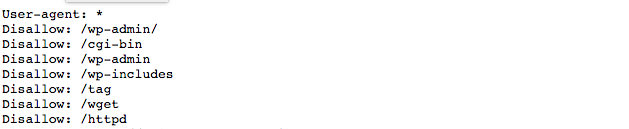
This has been down to the said items being blocked (Disallow) by default via WordPress’s virtual robots.txt file.
As it’s a virtual file you cannot simply open and edit the file – it doesn’t physically exist!

There are probably a few plugins that can help with this but, in my opinion, the less plugins installed the better so the quickest, easiest way to solve this is to just add a few lines of code to the theme functions.php.

Below is a simple few lines to add, all you have to do is change the file path that is currently blocked.

Step 1:
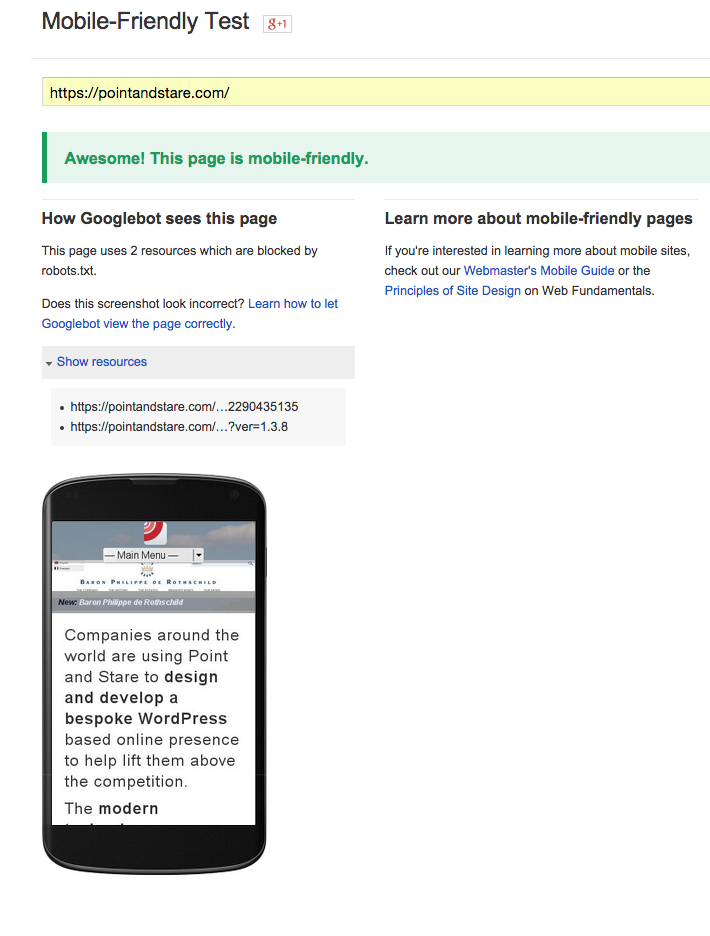
Go to the Google Mobile Friendly test site and run a quick test on your site.
Once you’ve run the test, if the results show files are inaccessible, click ‘Show resources’ to view the file paths.

Google Mobile Friendly Test

Step 2:
Presuming you have some blocked resources (caused by a Disallow in the robots.txt), you can unblock them (Allow) by adding the following to your theme functions.php

add_filter( 'robots_txt', 'pands_robots_mod', 10, 2 );
function pands_robots_mod( $output, $public ) {
$output .= "Allow: PATH/TO/THE/BLOCKED/FILE" . "\n";
return $output;
}

Don’t forget to change the /PATH/TO/THE/BLOCKED/FILE.

Before:
Disallow all the things

After:
Allow some of the things

Step 3:
Relax with a cocktail knowing you’ve allowed all the things correctly unless you’re looking for someone to sort this for you, in which case, get in touch.

Edge Structures

Edge Structures

Client: Edge Structures
Brief: Working with one of the UK’s best structural engineering design studios to build an impressive, clean WordPress based website.

The brief was straightforward enough – build something we can be proud of – ‘we’ being all involved parties.
Designed by Found Design our task was to simply develop an easy to use admin area that, on the front end works seamlessly across all major browsers and devices.

The client even gave us a lovely testimonial:
“Fantastic service by Point & Stare who made it easy for us to ensure that everything ran smoothly. Very professional, very helpful.
We are really happy with our new website. It looks professional, stylish and is really easy to update.
We would highly recommend Point & Stare to any company seeking to take their web presence to the next level.”